 Meeting Diverse Needs for Small Batches, Multiple Varieties & Short Lead Times

 English
 Español
 عربى

A Copper-Clad Graphene Wire Trades Weight for Diameter
Copper-Clad Graphene Wire with a 30 percent copper ratio, such as the CCAQZY-2/180 from Zhejiang Changran Technology, replaces part of the copper in a winding with a lighter core, and the trade can be worked out with simple arithmetic. The conductor is offered from 0.10 to 4.00 mm in solid, stranded or shaped form, with polyesterimide, polyamide-imide or composite enamel in 180, 200 and 220°C classes. Conductivity depends on the core and the cladding, so the numbers below are estimates built from stated assumptions.
Estimating a 30 Percent Ratio
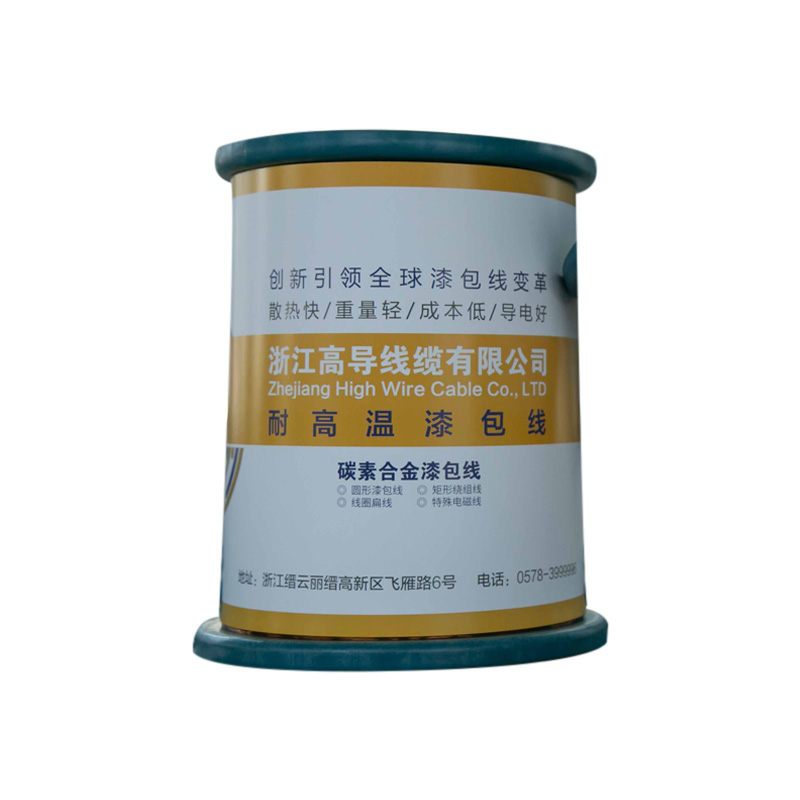
The estimate for a Copper-Clad Graphene Wire treats the copper ratio as a share of cross-section and the core as pure aluminum at 61 percent IACS, where annealed copper equals 100. The effect of graphene on the core is left out because its effect is not quantified here. Current runs through both metals in parallel, so conductivity is the weighted average: 0.30 x 100 + 0.70 x 61 = 72.7 percent IACS. Density follows the same weighting: 0.30 x 8.96 + 0.70 x 2.70 = 4.58 g/cm³, about 51 percent of copper's 8.96.
|
Copper ratio |
Conductivity (% IACS) |
Mass at same diameter |
Diameter at equal resistance |
Mass at equal resistance |
|
10% |
64.9 |
0.37 |
1.24 |
0.57 |
|
20% |
68.8 |
0.44 |
1.21 |
0.64 |
|
30% |
72.7 |
0.51 |
1.17 |
0.70 |
|
Pure copper |
100 |
1.00 |
1.00 |
1.00 |
Values are relative to copper of the same length.
Same Diameter Means Lighter and More Resistive
At the same diameter, a 30 percent wire weighs about half as much as copper. Its resistance is 100 / 72.7 = 1.375 times higher, so at the same current it produces 37.5 percent more heat. A Copper-Clad Graphene Wire is therefore not a drop-in replacement for copper when the diameter is fixed by a slot or a bobbin.
Same Resistance Means Larger but Still Lighter
To match copper's resistance, the cross-section grows by 1.375 and the diameter by its square root, 1.17. A 1.00 mm copper wire is matched by about 1.17 mm of Copper-Clad Graphene Wire, which weighs 1.375 x 0.51 = 0.70 of the copper, a saving of about 30 percent. The table shows the compromise: a 10 percent ratio saves more weight but needs a diameter 24 percent larger, while the 30 percent ratio stays closer to copper in size.
Winding Window
A slot packed with 1.00 mm copper cannot take 1.17 mm Copper-Clad Graphene Wire turn for turn. The conductor area per turn rises 37.5 percent, so a full slot holds about 27 percent fewer turns. The substitution suits windings with spare room, or new designs drawn around the larger wire. Adjustable conductor structure, insulation coating and dimensional tolerances are the parameters that adapt a design to that change.
Thermal Class and Enamel
At matched resistance, a Copper-Clad Graphene Wire loses the same power as the copper wire, so the thermal class of the existing design carries over. At the same diameter, the extra 37.5 percent of heat is where the 200 and 220°C options give headroom beyond the 180°C system. Polyamide-imide and composite coatings are the usual choices when a winding runs hot.
Where the Trade Pays Off
Applications include motors, transformers, inductors, industrial electromagnetic coils, power tools and new energy equipment. Weight counts in handheld tools and moving coils. Copper cost counts in volume windings, because aluminum costs a fraction of copper per kilogram. The copper layer on the surface keeps terminations solderable, which bare aluminum, with its oxide film, does not.
For a design with room in the winding window, Copper-Clad Graphene Wire gives a lighter coil at the same resistance. For a design that is already full, copper remains the simpler route. Zhejiang Changran supplies small batches, multiple varieties and short lead times, which suits trial windings where the diameter and ratio are still being tuned. A Copper-Clad Graphene Wire decision starts with the arithmetic above and ends with a test coil.

- (+86) 578-3999996
- (+86) 15088455116
- 820381596@qq.com
- Yanghao Block, Suichang Economic Development Zone, Yunfeng Subdistrict, Suichang County, Lishui City, Zhejiang Province, China
Copyright © Zhejiang Changran Technology Co., Ltd. All rights reserved.
